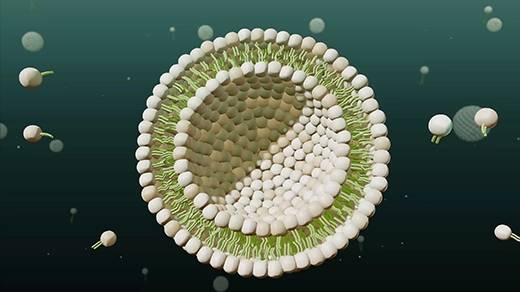
Is self-enclosure life’s greatest trick? According to the lipid-first theory of the origin of life, a cell membrane gave primordial chemistry a place to gather.
Introduction
This explainer is part of Quanta Magazine’s Origins of Life Week. Check back throughout the week for more stories about one of science’s biggest unknowns.
At its core, every cell is just a bubble of chemistry sealed inside a membrane. In modern cells, that chemistry is extraordinarily complex, orchestrating some 1 billion reactions per second. Likewise, its container, the lipid membrane, is built and maintained by elaborate biochemical mechanisms. But even the much simpler first cells would have needed a bubble too.
Without a physical boundary corralling molecules into a small space, whatever it was that turned into early life would have been too dispersed to assemble the complex systems that life requires, said Bruce Damer, an astrobiologist at the University of California, Santa Cruz. “You need a container before you can get the chemistry.”
To some researchers, the cell membrane seems so essential to life’s functions that they propose it as the origin of life. In this framework, known as the “lipid first” hypothesis, Earth transitioned from a mess of primordial chemistry to something recognizably alive because of those containers.