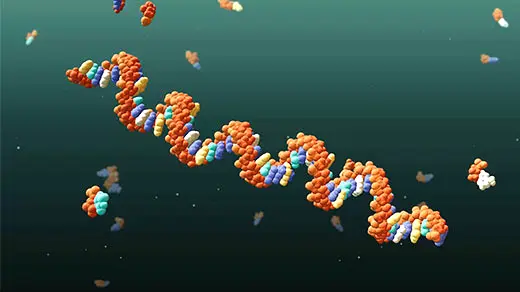
Some believe the earliest life emerged from self-copying molecules that could mutate and even evolve. But that may not have been enough.
Introduction
This explainer is part of Quanta Magazine’s Origins of Life Week. Check back throughout the week for more stories about one of science’s biggest unknowns.
There’s scarcely any corner of Earth in which life hasn’t gained a foothold. Living organisms shape the clouds, the climate, even the rocks. But how life first appeared on a barren planet some 4 billion years ago remains one of the biggest questions for science. Many researchers believe that self-replication — an ability to reliably store and copy genetic information — is life’s most core ability. If that’s true, then the earliest life-forms would presumably have needed the sorts of biomolecules that life uses to store and copy genetic information today.
The DNA molecule is the star of this process; it encodes the forms of the protein molecules that enable chemical reactions in cells. To translate the genetic information in DNA into the chemical structure of proteins, cells use RNA. The trouble is, in modern cells, proteins are involved in every step of this process: They duplicate DNA when cells divide, they transcribe DNA into RNA, and they help to use RNA for making more proteins. This creates a chicken-and-egg problem: Useful proteins can’t be made in cells without DNA, but proteins are needed to make DNA in the first place.